

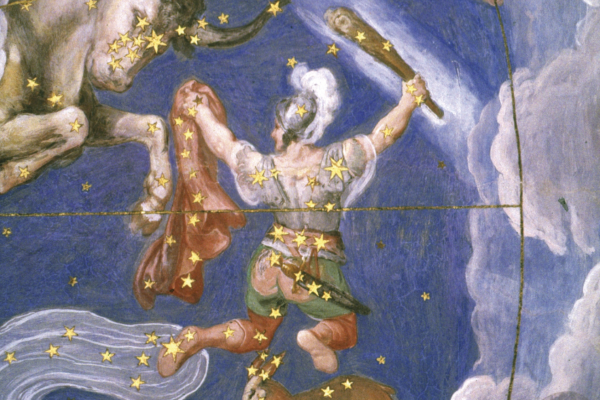
However, here in the southern hemisphere Orion appears upside-down, as if his bright and beautiful stars are doing a spectacular cartwheel across our summer sky.
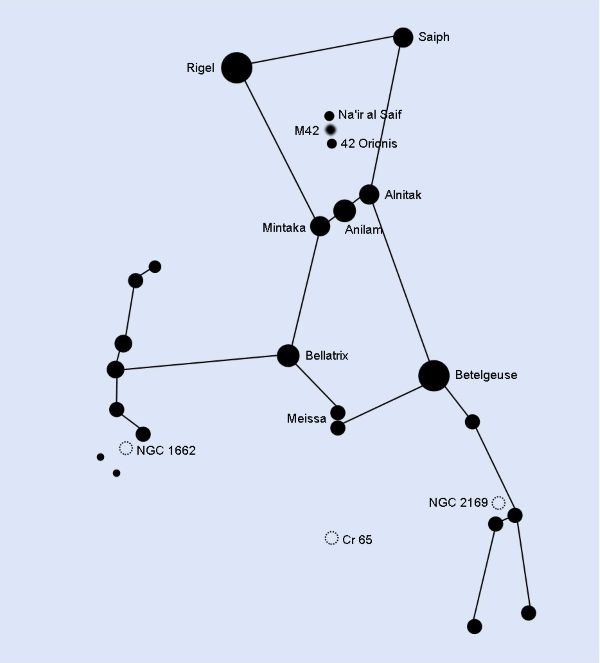
Depending on the month and the time of night, turn the star chart so that its stars match the orientation of Orion’s stars in the sky.
How far away are Orion’s stars?
Observed from Earth, the night sky appears two-dimensional. But stars are scattered through three-dimensional space, so their patterns just happen to be aligned in such a way that they appear close together from our perspective. The image below shows you how far in light-years Orion’s brightest stars are from Earth. (One light-year is the distance light travels in a single year, about 10 trillion kilometers.)

Orion’s Superstars
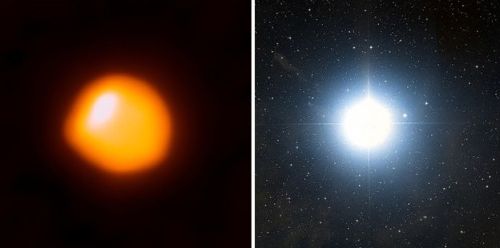
Although all of the main stars outlining Orion’s body and belt are dazzling giants or supergiants, two take centre stage: Betelgeuse and Rigel. Noticeably red Betelgeuse’s name is from the ancient Arabic for “shoulder of the giant”. Located 429 light-years away, it is a massive red supergiant and it’s one of the biggest stars we know. With a diameter of 1.5 billion kilometres, if it replaced the Sun at the centre of our solar system, it would extend past the orbit of Jupiter.
Due to its giant mass, Betelgeuse leads a fast and furious life and at 10 million years of age is already nearing the end of its life (compared to our middle-aged 5 billion-year-old sun, which will die at the ripe of old age of around 10 billion years). Betelgeuse will die in spectacular fashion by blowing itself to smithereens in a supernova explosion in the not too distant future. Indeed, Betelgeuse may have blown up yesterday afternoon, but we won’t know for another 429 years when the light eventually reaches us!
Meissa: Orion’s Head – Collinder 69 (Open Cluster)
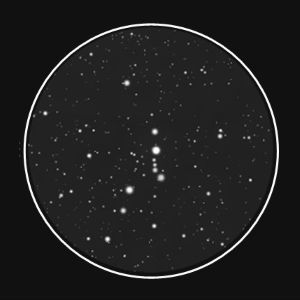
Naked eye, Orion’s head appears as an isosceles triangle made up of three small stars. The brightest of the stars is the hot blue giant, Meissa, whose name comes from the ancient Arabic for “the shining one”. A pair of binoculars reveals the three stars are part of a small but attractive open cluster of stars, named Collinder 69. (An open cluster is a group of stars that were born from the same cloud of gas and dust, all of which are gravitationally bound and moving together through space like a school of stellar fish, but the stars will eventually disperse and cease being a cluster.)
The cluster is young, in astronomical terms, and probably formed around five million years ago. It still has remnants of its nebulous star birth cloud softly enveloping the stars, but alas, not visible in binoculars. The dozen or so stars that you can see are dominated by the brilliant white Meissa, and the other two bright stars in the field of view are the blue-white Phi-1 and the yellow Phi-2 Ori, which is actually a foreground star and not part of the cluster.
Orion’s Belt – Collinder 70 (Open Cluster)
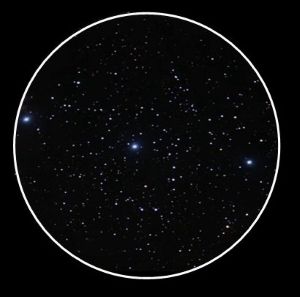
Naked eye, Orion’s Belt is a magnificent cosmic wonder with its three exceptionally hot and massive young blue supergiants evenly spaced in a line at a jaunty angle. (They are also sometimes known as the ‘Three Sisters’.) Looking at the three belt stars through a pair of binoculars is a spectacular surprise because there is no indication naked eye of what you will see… the three very bright stars surrounded by loads of stars that fill up the field of view.
They are all part of the rich open cluster open cluster called Collinder 70. It’s a tremendous view because there is a large range of brightness, from the very bright belt-stars to very faint stars and they are scattered everywhere. Like other rich clusters, you will see some lovely patterns in the cluster – the most prominent one being the way the stars wind themselves in a gorgeous long starry chain around the three brilliant supergiants.
Orion’s Sword
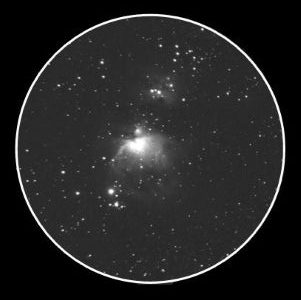
M42: The Great Orion Nebula (Star-birth Cloud)
Naked eye, the middle “star” in Orion’s Sword looks decidedly fuzzy, but it’s not a fuzzy star at all… it is one of the sky’s greatest celestial treasures: the nearest and most active stellar nursery to Earth, where baby stars are being born from the vast cloud of gas and dust. Most nebulae are difficult if not impossible to see with the unaided eye or even binoculars. But the Orion Nebula is in a class all of its own. It’s bright enough to be visible even in light-polluted conditions, and under a dark sky it’s truly stunning.
The nebula lies 1,300 light-years away, it is about 24 light-years across and is about 2 million years old. It is home to some of our galaxy’s youngest, and hottest stars. In binoculars it is a beautifully soft cloud of nebulosity with two of its superb baby stars glittering in the misty nebula. Take your time with the Orion Nebula — the longer you look, the more you’ll see. It really is extraordinary to think that stars are actually being formed within this glowing cloud as you look at it.
Na’ir al Saif & NGC 1980 (Open Cluster):
Na’ir al Saif is the brightest star in Orion’s sword. Its name is Arabic for “the Bright One in the Sword.” Although we can only see one star, it is actually a complex quadruple star. It is the lucida (brightest member) of the small open star cluster called NGC 1980. The cluster is around 4.7 million years old, and it is lovely in binoculars with the smaller sparkling stars showing a nice range of brightness.
42 + 45 Orionis (Stars)
The faintest of the three naked-eye stars in Orion’s Sword is revealed to be two lovely stars in binoculars – 42 Orionis and 45 Orionis. They are wrapped in a gauzy nebula which carries three separate entries in the New General Catalogue – NGC 1973, NGC 1975, and NGC 1977 – although it’s actually the same complex. However, the nebulosity isn’t visible in binoculars, although some observers have seen faint and ghostly tendrils of nebulosity just south of 42 and 45 Orionis (1977), and then only under exceptionally dark and clear skies.
NGC 1981 (Open Cluster)
Just a little way further south, you can’t miss a bright grouping of stars called NGC 1981. This cluster was made for binocular observing! Some observers say it looks like a little gecko, with the easternmost star as its snout, the westernmost as its tail and the two groups of three stars in the middle making up its two sets of legs!
Collinder 65 (Open Cluster)
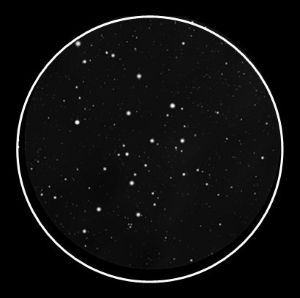
Collinder 65 lies right on the border with Taurus, and with a diameter of nearly 4°, it is beautiful in 10×50 binoculars! There are heaps of stars, around 50 or so, and you will see some lovely chains and groups of stars, with the lovely stars dominated by the gorgeous orange coloured star, 119 Tauri, a red supergiant similar to Betelgeuse, that lies to the north.
NGC 1662 (Open Cluster)
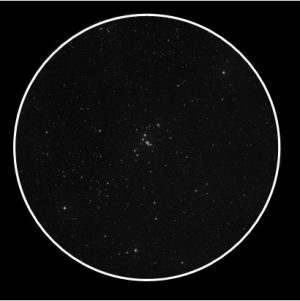
Open cluster NGC 1662 forms a right-angle triangle with the two stars at the top of Orion’s shield, with Pi-1 Orionis (the star at the top of the shield) sitting in the right angle. The cluster itself appears as a small, curved knot of small, faint stars lying in a misty haze of unresolved stars.
NGC 2169 (Open Cluster)
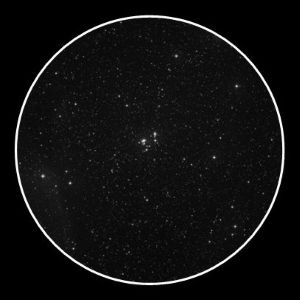
NGC 2169 forms the tip of an isosceles triangle with the two stars Xi and Nu Orionis. This small, bright open cluster is made up of about 30 stars but in a pair of binoculars you can see the four brightest cluster members buried in the misty glow of the other unresolved stars.
Copyright © Susan Young 2025