

Two globular clusters… two galaxies… one field of view
15 November 2025
Can there be anything more extraordinary than to see two globular clusters from two different galaxies in one eyepiece field of view? Especially when one globular is arguably the most beautiful of them all… 47 Tuc (NGC 104) who roams the halo of our Milky Way Galaxy and lies around 16,000 light-years away, while the other – NGC 121 – lives in the Small Magellanic Cloud, 200,000 light-years away.
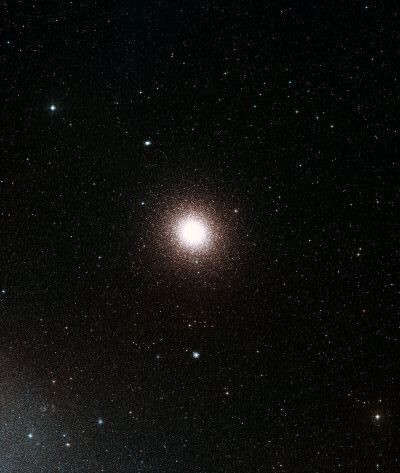
At 90x in my 16-inch f 4/5 Dobsonian, 47 Tuc (mag 4.1) is spectacular; a brilliant and immensely rich ball of glittering starlight, with its famously dense core. In striking contrast, NGC 121 (mag 11.24), lying ~35′ to the northeast, appears as a small, fairly faint, condensed little glow – as one would expect of an extragalactic globular cluster.
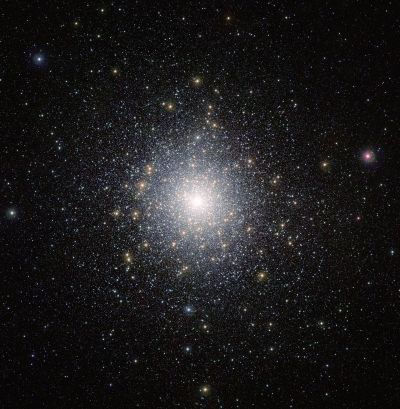
47 Tuc
Nicolas-Louis de Lacaille:
47 Tuc was discovered by Nicolas-Louis de Lacaille, 1751-1752, while at the Cape of Good Hope. He used a 1/2″ telescope at 8x and the globular was the first object listed in his 1755 catalogue as Class I No. 1. He described it “Like the nucleus of a fairly bright comet.”
The globular certainly impressed its next two observers…
James Dunlop:
James Dunlop observed it from Paramatta, New South Wales, using a 9-inch f/12 telescope. He included it as No. 18 in his catalogue of 1827 and described it as “a beautiful large round nebula, about 8′ diameter, very gradually condensed to the centre. This beautiful globe of light is easily resolvable into stars of a dusky colour. The compression to the centre is very great, and the stars are considerably scattered S.p. and N.f.”
John Herschel:
John Herschel observed it frequently during his stay at the Cape of Good Hope during the years 1834 – 1836. Using his 20-foot (18¼-inch aperture) telescope, he observed it for the first time on 11 April 1834 and described it as “the great cluster preceding the Nubecula Minor. Estimated diameter of the denser portion 5′; of the whole (not, however, including loose stragglers) 8′. Stars 14..16 mag. and one of 12th mag N.p. the centre. Excessively compressed. (N.B. In a sweep below the pole, when of course owing to the low altitude much of the light was lost.)” His observations of 12 August 1834 described it as: “A most glorious cluster. The stars are equal, 14th mag., immensely numerous and compressed. Its last outliers extend to a distance of 2 minutes, 16 seconds in RA from the centre. It is compressed to a blaze of light at the centre, the diameter of the more compressed part being 30 arcsec in RA. It is at first very gradual, then pretty suddenly very much brighter in the middle. It is completely insulated. After it has passed, the ground of the sky is perfectly black throughout the whole breadth of the sweep. There is a double star 11th mag. preceding the centre (Pos. 226.5 – 6.5 arcsec in RA from centre of neb.)”
On 21 September 1835 he observed it again and noted: “Fills the field with its stragglers, condensation in three distinct stages, first very gradually, next pretty suddenly, and finally very suddenly very much brighter in the middle up to a central blaze whose diameter in RA is 13.5 seconds and whose colour is ruddy or orange-yellow, which contrasts evidently with the white light of the rest. The stars are all nearly equal (12..14 mag). A stupendous object.”
His final record of the object was made on 5 November 1836 when he called it “A most magnificent globular cluster. It fills the field with its outskirts, but within its more compressed part, I can insulate a tolerably defined circular space of 90 arcsec diameter wherein the compression is much more decided and the stars seem to run together; and this part I think has a pale pinkish or rose-colour.”
He sketched the cluster, showing its appearance “as seen on a great many other occasions.” He noted that “the contrast between the rose-coloured light of the interior and the white of the exterior portions cannot, of course, be represented in an engraving, but of the phenomenon itself, I have no doubt. The double star on the S.p. edge of the more condensed portion has probably no connexion with the cluster.” Referring to its overall shape, he notes “its figure is round, and not elliptic – (at least not so elliptic) as described and figured by Mr. Dunlop.”
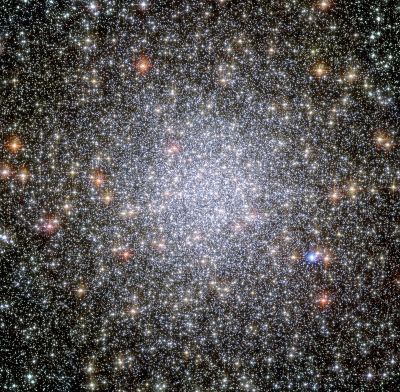
I’ll never tire of looking at this globular cluster; to me it defines the essence of globular clusters – awe-inspiring, mysterious and breathtakingly beautiful. From naked eye to my 10×50 binoculars to my 16-inch Dobs, this wondrous swarm of ancient stars is among the most beautiful sights in our night sky, and it stirs me to my core.
Naked eye it is a small, fairly bright glow, absolutely stunningly located close to the Small Magellanic Cloud. In my 10×50 binoculars it is a beautiful, bright, soft, pearly ball of light with a noticeable increase in brightness toward the centre.
At 228x in the 16-inch Dobs it is simply breathtaking. It is incredibly resolved into several thousand stars out to a diameter of over 25′. The concentration of stars increases steadily to the blazing 4′ core, that itself is resolved right down to a very small, bright nucleus. Like all globular clusters, the longer you look, the more intricate and beautiful the view becomes – the spiralling arms of stars that swirl outwards from the core, the layers of stars upon the layers of starlight, the small dark bars and patches that slice into the brilliant glow, the tangles of starlight that take shape and resolve into stars, the beautiful tight core that looks like a luminous ball of brilliant starlight dusted with crushed diamonds.
NGC 121
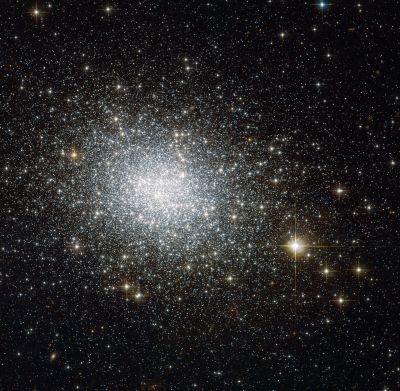
NGC 121, which is located about 2.3° northwest of the SMC galactic centre, is the SMC’s sole ancient globular cluster. It is around 10 billion years old, which is several billions of years younger than its counterparts in the Milky Way and the Large Magellanic Cloud. Currently, no-one knows why, but it appears that the SMC lacks the very oldest GCs that are found in other massive Local Group galaxies. The rest of the SMC’s globular clusters (15 thus far) are in the “intermediate-age” category. Three of them are ~8 billion years old; the others are considerably younger.
John Herschel discovered NGC 121 on 20 September, 1835, while in South Africa surveying the southern skies. He logged it as “pretty bright; a little extended; very gradually brighter in the middle; 40” dia.”
At 228x in the 16-inch Dobs it appears as a fairly bright, just off-round glow, ~1.2′ in diameter, and with a gradually brightening core. No stars are resolved. A mag 12 star lies 1′ W of centre, just off the halo.
h